Mississippi Genealogy
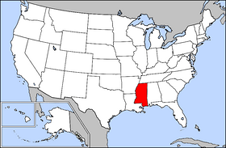
USA (1,403,636) > Mississippi (26,134)
By Record Type

Mississippi Genealogy Research Guide
If you're not sure which records would be helpful, you can try our Ancestor Source Finder tool.
|
Birth Records (103) Cemetery Records (14,368) Census Records (2,611) Church Records (242) City Directories (400) Court Records (197) Death Records (463) Histories and Genealogies (574) Immigration Records (89) Land Records (654) |
Map Records (810) Marriage Records (491) Military Records (930) Minority Records (119) Miscellaneous Records (158) Newspapers and Obituaries (2,666) Probate Records (425) School Records (1,423) Tax Records (167) |
By County
By City
Mississippi Genealogy Research Guide
Quick Facts
Mississippi became the twentieth state in 1817, formed from the western half of the Mississippi Territory. Its records carry the imprint of a layered colonial past — French, British, and Spanish rule in the Natchez District long before American control — and of a distinctive county court system in which one office keeps land and estate records while another keeps marriages. As a public-domain state, Mississippi's first land titles came from the federal government, which makes federal land records central to research here.
- Capital: Jackson, the permanent seat of government since 1822. The territorial and first state capital sat at Natchez and the neighboring town of Washington, where the constitutional convention met in 1817.
- Statehood: December 10, 1817, the twentieth state, formed from the western portion of the Mississippi Territory (organized in 1798); the eastern portion became the Alabama Territory.
- Land type: Mississippi is a federal-land (public-domain) state. Original title passed from the United States through the General Land Office, so the first sale of most land is documented by federal patents, tract books, and survey plats; later transfers between individuals are recorded as deeds at the county level.
- Counties: 82. The earliest were Adams (1799) and Pickering — renamed Jefferson in 1802 — laid out under the territorial government in the Natchez District; the last, Humphreys County, was created in 1918.
- Nickname and motto: the Magnolia State; the state motto is Virtute et Armis ("By Valor and Arms").
- Where records live: most genealogical records are kept at the county level and divided between two offices — the Chancery Clerk, who keeps deeds, wills and estate files, guardianships, and divorces, and the Circuit Clerk, who keeps marriages and civil and criminal cases — with statewide records at the Department of Archives and History and the State Department of Health.
Libraries and Archives
The center of gravity for Mississippi research is the state archives in Jackson, which holds the state's own records and has microfilmed the surviving records of nearly every county courthouse; university special collections, regional genealogy libraries, and the National Archives facility serving the Southeast fill in the rest. The principal repositories include:
- Mississippi Department of Archives and History (Jackson) — the central state repository: county-record microfilm, Confederate service and pension records, state and territorial census returns, tax rolls, official state records, manuscripts, newspapers, and published genealogies, with an online catalog and a growing digital archive.
- Mississippi State University Libraries, Special Collections — Mississippiana, manuscripts, and the Congressional and Political Research Center.
- University of Mississippi Archives and Special Collections — the J.D. Williams Library's manuscripts, family papers, and Mississippiana.
- University of Southern Mississippi Libraries — the McCain Library and Archives, strong in Mississippiana, church records, and regional history.
- National Archives at Atlanta — the branch serving Mississippi, with federal court, naturalization, census, and military records for the state.
- Mississippi Genealogical Society and the Mississippi Historical Society — the statewide societies, publishers of compiled records and of the Journal of Mississippi History.
- The FamilySearch Library and its worldwide FamilySearch Centers hold extensive Mississippi microfilm and digital collections, and the county Chancery Clerk and Circuit Clerk offices, along with local libraries and historical societies, hold records for their own areas.
Major Websites
These sites host digitized Mississippi records and indexes. Subscription sites are marked ($).
- FamilySearch — free; the backbone finding aid, with the FamilySearch Wiki, catalog, and large digitized collections of Mississippi vital, land, probate, court, church, and tax records.
- Ancestry ($) — extensive Mississippi vital, census, probate, land, military, and court collections.
- MyHeritage ($) — Mississippi death, marriage, land, and immigration collections.
- Findmypast ($) — Mississippi marriage and other record sets.
- Mississippi Department of Archives and History Digital Archives — free; digitized record series, photographs, and documents drawn from the state archives.
- Mississippi Digital Library — free; a shared collection of digitized manuscripts and photographs from archives and universities across the state.
- MSGenWeb — free; volunteer-transcribed county records, including marriages, wills, deeds, cemetery, and Bible records.
- Chronicling America — free; the Library of Congress historical newspaper archive.
- Internet Archive and HathiTrust — free; digitized Mississippi histories, published record abstracts, and law books.
- Find a Grave and BillionGraves — free; cemetery listings, photographs, and transcriptions.
Law and Government
Mississippi's statutes and legislative records explain the jurisdictions and record-keeping practices that produced its genealogical records, and the foundational codes are digitized and free to read.
- The Statutes of the Mississippi Territory (Toulmin, 1807) — the first digest of territorial law, gathering the acts then in force together with the federal Constitution and the Northwest Ordinance; free on HathiTrust.
- Thompson's histories of the Mississippi codes — free; a code-by-code account useful for learning which laws governed which records at a given time.
- The annual Laws of Mississippi (session laws) and the nineteenth-century digests are also digitized on the Internet Archive and HathiTrust.
Vital Records (Birth, Marriage, Death)
Statewide registration is late in Mississippi. The State Department of Health did not begin recording births and deaths until November 1912, and compliance was general only by the early 1920s; a handful of counties kept limited birth and death registers as early as 1879. Marriages, by contrast, were recorded at the county level by the Circuit Clerk from each county's early years, though many pre-1850 marriage records have been lost. Before 1912, church registers, family Bibles, tax lists, and cemetery records are the essential substitutes for births and deaths, and African American vital records are sometimes indexed separately.
Births and deaths (statewide, from 1912). Birth and death certificates are held by the Mississippi State Department of Health; a fee applies, and access is restricted — births are closed for 100 years and deaths for 50, with earlier access for qualified applicants. Those born before 1912, or lacking a certificate, may apply for a delayed birth record. Use these indexes to identify a record:
- Deaths: Mississippi Death Certificate Index, 1912–1943 — free on FamilySearch; also on Ancestry ($) as the Index to Deaths, 1912–1943. Earlier deaths and burials appear in Mississippi Deaths and Burials, 1822–1921 — free on FamilySearch.
- Marriages: Mississippi Marriages, 1800–1911 and Mississippi County Marriages, 1858–1979 — both free on FamilySearch; a Mississippi marriage index is also on Findmypast ($).
Statewide marriage registration began in 1926; the State Department of Health holds marriage records from 1926 to 1938 and from 1942 onward, the county Circuit Clerk holds the 1938–1942 interim, and the Department of Archives and History holds an index to marriages before 1926.
History and Timeline of Major Events
Key dates that shaped Mississippi's jurisdictions and records:
- 1540 — Hernando de Soto's expedition crosses the region and the Mississippi River.
- 1699 — France establishes Fort Maurepas (Old Biloxi), the first permanent European settlement on the Gulf Coast.
- 1716 — Fort Rosalie is built at Natchez, the oldest town on the Mississippi River.
- 1729 — The Natchez destroy the French settlement at Fort Rosalie, and the Natchez people are dispersed in the war that follows.
- 1763 — Britain gains the region after the Seven Years' War, and it becomes part of British West Florida.
- 1779–1781 — Spain takes the Natchez District during the American Revolution and administers it for the next fifteen years.
- 1798 — Congress organizes the Mississippi Territory after Spain relinquishes its claim under the Treaty of San Lorenzo.
- 1811–1813 — The territory is enlarged, and Mississippi militia serve in the Creek War.
- December 10, 1817 — Mississippi is admitted as the twentieth state; the eastern territory becomes Alabama.
- 1822 — The capital is established permanently at Jackson.
- 1830 — The Treaty of Dancing Rabbit Creek cedes the remaining Choctaw lands and opens the east-central and northern counties to settlement.
- 1832 — The Treaty of Pontotoc Creek cedes the Chickasaw lands of north Mississippi.
- 1861–1865 — Mississippi secedes on January 9, 1861, and becomes a major theater of the Civil War; Vicksburg falls on July 4, 1863.
- 1865–1870 — Reconstruction; the Freedmen's Bureau operates across the state, and Mississippi is readmitted to the Union in 1870.
- 1890 — A new state constitution is adopted.
- 1870s–1930s — Fires destroy the records of a number of county courthouses (among them Kemper, Panola, Pike, and Newton); the state archives holds microfilm of much that survives.
- 1918 — Humphreys County, the last of the eighty-two counties, is created.
Census Records and Substitutes
Federal censuses survive for Mississippi from 1820 onward and were taken every ten years; the 1830 schedule is missing Pike County, the 1860 schedule is missing Hancock, Sunflower, and Washington counties, and the 1890 federal census was destroyed nationwide. The Mississippi Territory also appears on the 1800 and 1810 federal censuses. Federal censuses are free on FamilySearch and are also searchable on Ancestry ($) and MyHeritage ($).
Territorial and state censuses partly fill the gaps between the federal years, though they survive only in scattered form and not for every county. Spanish colonial censuses of the Natchez District from the 1780s and 1790s survive in print, and territorial enumerations were taken in 1801, 1805, 1808, 1810, and 1816. State censuses followed at intervals — among them 1818, 1820, 1822, 1823, 1824, 1825, 1837, 1840, 1841, 1845, 1850, 1853, and a valuable Reconstruction-era enumeration in 1866. Most of the earlier schedules name only the head of each household with statistical counts of the others, in the manner of the early federal censuses; the surviving returns are gathered in the Mississippi State and Territorial Census Collection, 1792–1866 ($).
Substitutes. Where censuses are missing, the Mississippi Compiled Census and Census Substitutes Index, 1805–1890 ($) draws together tax lists, voter and militia rolls, and similar sources, and the Enumeration of Educable Children — free on FamilySearch — lists school-age children by county for much of the nineteenth and early twentieth centuries. City directories and tax lists (below) are the other main substitutes for placing a family in a given year.
Church Records
Because civil registration is so late, church records are the most important substitute for births, marriages, and deaths before 1912. The largest denominations are Baptist — the first congregation was gathered near Natchez in 1791, and Southern Baptist and, after the Civil War, independent Black Baptist churches became the most numerous — along with Methodist and Presbyterian churches across the state, Roman Catholic parishes on the Gulf Coast and in the Natchez area dating to the French and Spanish periods, and Episcopal churches from the early statehood years.
- Mississippi Church Records, 1910–1919 — free on FamilySearch; a statewide gathering of congregational registers.
- Methodist conference minutes and registers are held at the J.B. Cain Archives of Mississippi Methodism at Millsaps College, and Catholic sacramental registers are held by the Diocese of Jackson (formerly the Diocese of Natchez, created in 1837) and by Gulf Coast parishes.
- Thousands of individual congregational registers — Baptist, Methodist, Presbyterian, and others — can be found through the FamilySearch Catalog by county and town, and abstracted church and Bible records appear in the collections of the Mississippi Genealogical Society.
Court Records
Mississippi's county courts are split between two clerks, and knowing which one held which records is the key to finding them; their records reach well beyond lawsuits into estates, guardianships, land, and naturalizations. The main courts a researcher encounters are:
- Chancery Court, in each county — the court of equity, which keeps deeds and land records, wills and estate files, guardianships, and divorces; its records are held by the Chancery Clerk.
- Circuit Court, in each county — the court of civil and criminal law, which keeps marriage records and, before 1906, most naturalizations; its records are held by the Circuit Clerk.
- Territorial and probate courts — the Superior Court of the Mississippi Territory (from 1798) and the early Orphans' and Probate Courts handled these matters before the chancery system took its modern form.
- The High Court of Errors and Appeals, forerunner of the Mississippi Supreme Court, heard appeals; its case files, many rich in family detail, are held at the Department of Archives and History.
Because a number of county courthouses have suffered fires, county holdings are uneven; in most cases the original record remains in the courthouse while the Department of Archives and History holds a microfilm copy. General guidance on the courts and their records is in the FamilySearch Mississippi court records guide.
Ethnic/Minority Records
Two histories dominate Mississippi's minority records: the large enslaved and, after 1865, free African American population, and the Choctaw and Chickasaw nations who held most of the state before removal. Knowing where a group lived points to the records most likely to document a family.
- African Americans. People of African descent were a majority of Mississippi's population for much of the nineteenth century, first overwhelmingly enslaved and named chiefly in estate inventories, deeds, and the 1850 and 1860 slave schedules. After emancipation the Freedmen's Bureau generated labor contracts, marriage records, and school and ration records; Mississippi Freedmen's Department records, 1863–1866 are free on FamilySearch, the broader Bureau records for the state are free on FamilySearch, and the Department of Archives and History holds a Freedmen's Bureau marriage index. The Freedman's Bank records (1865–1874) are a further key source.
- Choctaw and Chickasaw. The Choctaw ceded their lands in 1830 and the Chickasaw in 1832; those who removed to Indian Territory are documented in the removal rolls and, later, the Dawes enrollment records, both free on FamilySearch and at the National Archives, while the Mississippi Band of Choctaw Indians, descended from those who stayed, appears in twentieth-century Indian census rolls. Treaty and agency records are held at the National Archives at Atlanta and the Department of Archives and History.
Immigration and Naturalization
Mississippi was settled far more by internal migration than by immigration through its own coast, so passenger records are limited, but naturalizations were recorded here as elsewhere. Before 1906 any court of record — most often the county Circuit Court — could naturalize, so early records are scattered among the counties; after 1906 the process was federalized and handled by the federal courts.
- Mississippi Naturalization Records, 1907–2008 ($) — the principal statewide index and images for the federal period.
- The National Archives at Atlanta holds the federal naturalization records for the Northern and Southern Districts of Mississippi, and the Department of Archives and History holds a Works Progress Administration index to naturalizations in the Mississippi courts before 1906.
- Records of the few Gulf-port arrivals, such as at Pascagoula, are among the federal immigration records and can be searched free on FamilySearch.
Land Records
As a federal-land (public-domain) state, Mississippi disposed of its unsettled land through the United States rather than the state, so the first title to most tracts is a federal patent. After the Choctaw and Chickasaw cessions of 1830 and 1832 opened the interior, the land was surveyed into the rectangular township-and-range system and sold through a series of district land offices. Original title then passed to individuals, whose later sales are recorded as deeds by the county Chancery Clerk.
Federal land (first title).
- The Bureau of Land Management General Land Office Records site — free; the federal land patents (cash, credit, homestead, and military bounty), with survey plats and field notes, searchable by patentee and by legal description.
- The district land offices — among them Washington, Augusta, Jackson, Columbus, Chocchuma, Grenada, and Pontotoc — handled entries for different parts of the state before being consolidated into a single office at Jackson; their tract books and plats passed to the Bureau of Land Management, while the original survey plats and field notes are held by the state.
Colonial private land claims. In the Natchez District, land granted under British West Florida and Spanish rule had to be confirmed by United States commissioners after 1798; these confirmed British and Spanish claims are a distinctive early layer of Mississippi land title, and settlers already in possession held preemption and donation rights. Abstracts of these claims are printed in the federal land records and described in the FamilySearch Mississippi land guide.
County deeds and online search. Deeds are recorded by the county Chancery Clerk, and many county deed books have been digitized; FamilySearch Full-Text Search — free — makes many unindexed deeds, patents, and related papers searchable by every name they contain, including grantors, grantees, and witnesses. State-held land records are described among the holdings of the Department of Archives and History.
Military Records
Mississippians served in every American conflict from the territorial Indian wars onward, and the Civil War left by far the deepest record. The state archives is the central repository for Mississippi service and pension material.
- Territorial wars and War of 1812: Compiled Service Records of Volunteer Soldiers, 1812–1815 ($) covers Mississippi Territory units, including those in the Creek War; the Department of Archives and History also holds War of 1812 and Mexican War service records on microfilm.
- Civil War: Mississippi Civil War service records of Confederate soldiers, 1861–1865 are free on FamilySearch, with Union service records for Mississippi units also on FamilySearch. The Department of Archives and History holds the state's Confederate service records and the State Auditor's Confederate pension files (only Confederate pensions are held by the state; Union pensions are at the National Archives).
- Spanish-American War and World War I: the Department of Archives and History holds Spanish-American War service records and the Mississippi World War I statement-of-service cards, and county clerks have held veterans' discharge records since the early twentieth century.
Probate Records
Probate — wills, administrations of intestate estates, and guardianships of minors — is among the richest sources for family relationships, and in Mississippi it belongs to the Chancery Court. The Chancery Clerk in each county keeps the estate file, which typically names the widow and heirs; before the chancery system took its modern shape, these matters were handled by the territorial Orphans' and Probate Courts.
Online, Mississippi Probate Records are free on FamilySearch and browsable by county, and Mississippi Wills and Probate Records, 1780–1982 ($) is name-searchable across most counties. FamilySearch Full-Text Search also makes many unindexed wills and estate files searchable by every name they contain.
Tax Records
Tax lists place a family in a specific county and year and are valuable substitutes where censuses or deeds are missing; several consecutive years can reveal when a young man came of age, moved, or died and left heirs. Mississippi's tax rolls are unusually well preserved at the state level.
- The Department of Archives and History Digital Archives — free; holds the territorial tax rolls of the early 1800s and the county tax rolls (personal-property and land) that run through the nineteenth century, many of them digitized.
- The federal Civil War–era taxes — the United States Internal Revenue assessment lists of the 1860s and 1870s, which recorded income, licenses, and taxable goods — are free on FamilySearch for Mississippi.
- Later county tax assessment rolls are held by county officials, and abstracted early tax lists appear among the holdings of the FamilySearch Library and the state archives.
Back to Top